What will next quarter's promo calendar do to subscriptions?
Marketing could test six promo calendars in an afternoon instead of briefing an analyst and waiting two days.
Open the live demo- Role
- Requirements, model and build
- Context
- RCS MediaGroup
- Period
- 2025-2026
- Stack
-
- Python
- FastAPI
- JavaScript
- Object storage
- Excel export
Synthetic data — illustrative only. The demo is a rebuild, not real results.
Context
A subscription publisher planning promotions on a spreadsheet and a lot of argument. Acquisition: which offer, on which days, and what it costs the weeks around it.
For a startup: you are about to launch an aggressive discount. How many customers does it really bring, and how many are you just pulling forward from the weeks either side?
Question
How many new subscriptions should a promo calendar bring, how much of that is just seasonality, and how much is stolen from neighbouring weeks?
What I did
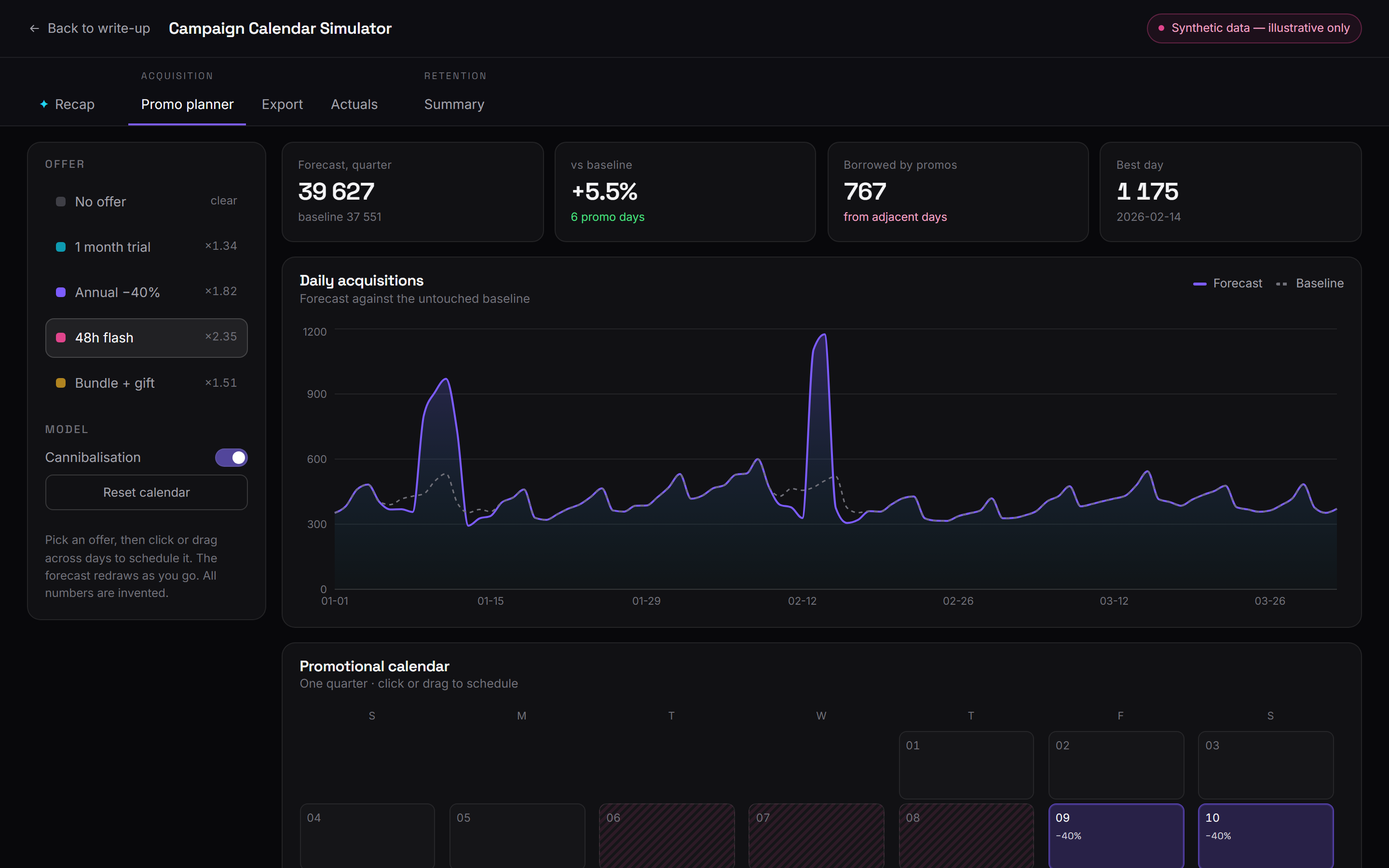
A deliberately transparent model: baseline, times seasonality, times offer strength, with an explicit cannibalisation term. Every factor is a number a planner can see and override. A model nobody can argue with does not survive a planning meeting.
Where it landed
In the planning process itself: a calendar the commercial team drags offers onto, with the forecast redrawing as they go. A recap shows the total and every input it depends on, each with its owner, so gaps get closed instead of argued over.
Effect
Whether to run an aggressive promo is now decided by also looking at what it takes from the weeks around it, not only at what it brings on the day. Planning moved from a spreadsheet plus an analyst request to a tool the team opens themselves. The live demo is a rebuild on synthetic data, so nothing in it is a real result.
- Reference inputs baseline, seasonality, offer lift
- Object storage flat files, refreshed by batch
- In-memory service gzipped JSON, one round trip
- Browser simulation redraws on every drag